
THANK YOU FOR SUBSCRIBING

× 
Education Technology Insights Weekly Brief
Be first to read the latest tech news, Industry Leader's Insights, and CIO interviews of medium and large enterprises exclusively from Education Technology Insights

Voyager Sopris Learning
Literacy Changes Lives When Educators Have the Right Support
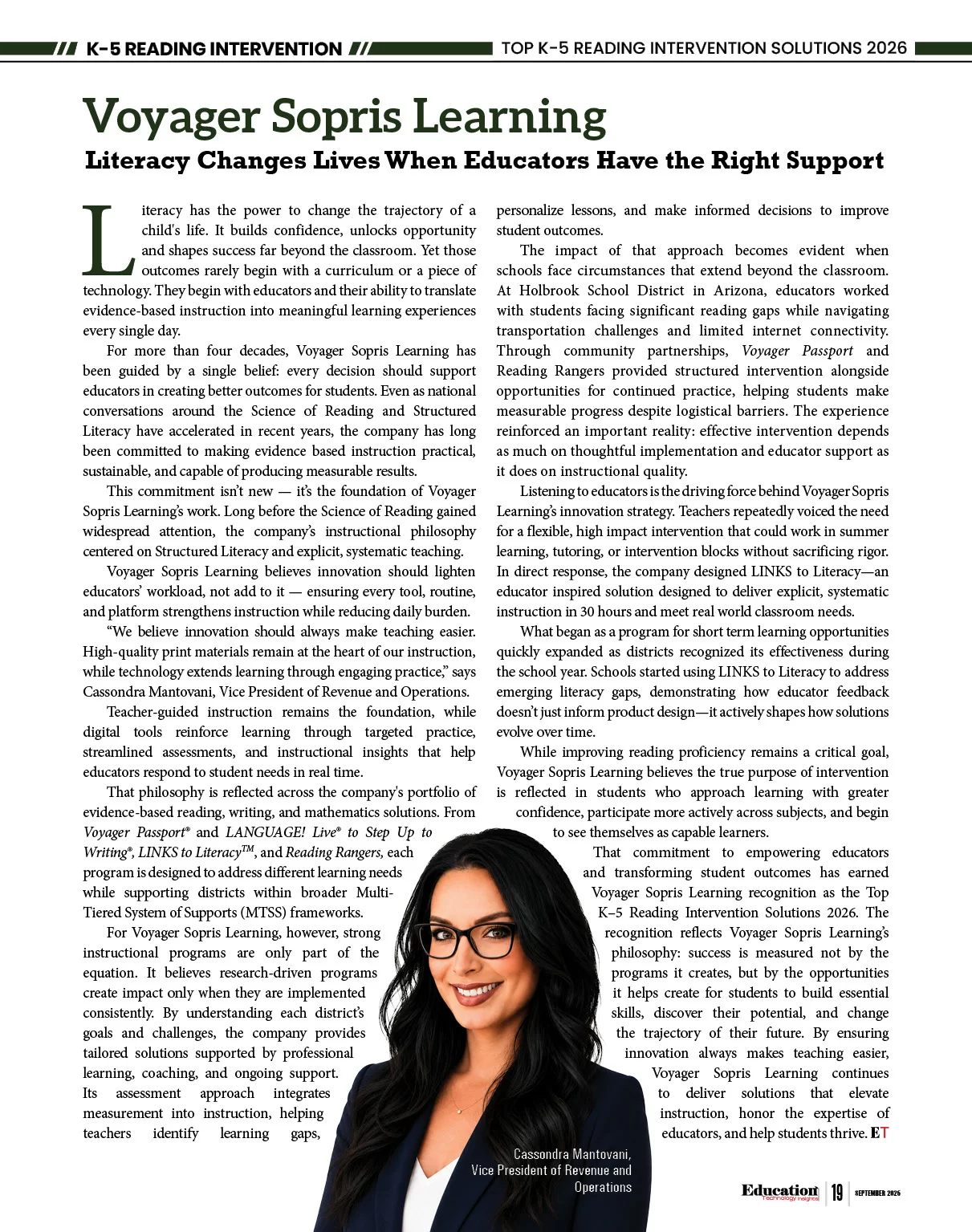
 Cassondra Mantovani, Vice President of Revenue and Operations
 For more than four decades, Voyager Sopris Learning has been guided by a single belief: every decision should support educators in creating better outcomes for students. Even as national conversations around the Science of Reading and Structured Literacy have accelerated in recent years, the company has long been committed to making evidence based instruction practical, sustainable, and capable of producing measurable results.
This commitment isn’t new — it’s the foundation of Voyager Sopris Learning’s work. Long before the Science of Reading gained widespread attention, the company’s instructional philosophy centered on Structured Literacy and explicit, systematic teaching.
Voyager Sopris Learning believes innovation should lighten educators’ workload, not add to it — ensuring every tool, routine, and platform strengthens instruction while reducing daily burden.
“We believe innovation should always make teaching easier.High-quality print materials remain at the heart of our instruction, while technology extends learning through engaging practice,” says Cassondra Mantovani, Vice President of Revenue and Operations.
Teacher-guided instruction remains the foundation, while digital tools reinforce learning through targeted practice, streamlined assessments, and instructional insights that help educators respond to student needs in real time.
That philosophy is reflected across the company's portfolio of evidence-based reading, writing, and mathematics solutions. From Voyager Passport® and LANGUAGE! Live® to Step Up to Writing®, LINKS to LiteracyTM, and Reading Rangers, each program is designed to address different learning needs while supporting districts within broader Multi-Tiered System of Supports (MTSS) frameworks.
For Voyager Sopris Learning, however, strong instructional programs are only part of the equation. It believes research-driven programs create impact only when they are implemented consistently. By understanding each district’s goals and challenges, the company provides tailored solutions supported by professional learning, coaching, and ongoing support. Its assessment approach integrates measurement into instruction, helping teachers identify learning gaps, personalize lessons, and make informed decisions to improve student outcomes.
The impact of that approach becomes evident when schools face circumstances that extend beyond the classroom. At Holbrook School District in Arizona, educators worked with students facing significant reading gaps while navigating transportation challenges and limited internet connectivity. Through community partnerships, Voyager Passport and Reading Rangers provided structured intervention alongside opportunities for continued practice, helping students make measurable progress despite logistical barriers. The experience reinforced an important reality: effective intervention depends as much on thoughtful implementation and educator support as it does on instructional quality.
Listening to educators is the driving force behind Voyager Sopris Learning’s innovation strategy. Teachers repeatedly voiced the need for a flexible, high impact intervention that could work in summer learning, tutoring, or intervention blocks without sacrificing rigor. In direct response, the company designed LINKS to Literacy—an educator inspired solution designed to deliver explicit, systematic instruction in 30 hours and meet real world classroom needs.
What began as a program for short term learning opportunities quickly expanded as districts recognized its effectiveness during the school year. Schools started using LINKS to Literacy to address emerging literacy gaps, demonstrating how educator feedback doesn’t just inform product design—it actively shapes how solutions evolve over time.
While improving reading proficiency remains a critical goal, Voyager Sopris Learning believes the true purpose of intervention is reflected in students who approach learning with greater confidence, participate more actively across subjects, and begin to see themselves as capable learners.
That commitment to empowering educators and transforming student outcomes has earned Voyager Sopris Learning recognition as the Top K–5 Reading Intervention Solutions 2026. The recognition reflects Voyager Sopris Learning’s philosophy: success is measured not by the programs it creates, but by the opportunities it helps create for students to build essential skills, discover their potential, and change the trajectory of their future. By ensuring innovation always makes teaching easier, Voyager Sopris Learning continues to deliver solutions that elevate instruction, honor the expertise of educators, and help students thrive.
Building Consistent K-5 Reading Intervention
A district can purchase a well-researched reading program and still watch intervention fragment across schools. Schedules differ between buildings, staffing changes midyear, students enter support with uneven skill profiles and intervention time competes with core instruction. The purchasing decision therefore reaches beyond lesson quality. Leaders must judge whether a program can produce consistent instruction without forcing every classroom into the same pace or delivery pattern.
Evidence alignment matters most when teachers can use it under ordinary school conditions. Explicit routines and cumulative skill development have little effect if materials are difficult to navigate or training ends after launch. Strong K–5 intervention should give teachers a clear instructional sequence while preserving room for regrouping, adjusted pacing, immediate correction and repeated practice. Print materials still carry practical weight because they keep the teacher at the center of instruction. Digital practice is useful when it extends a lesson and captures progress without displacing guided teaching or creating extra reporting work.
Placement is another common failure point. A broad intervention may appear comprehensive yet fit poorly within a district’s multi-tiered system of support. Buyers need to examine how the program complements core reading instruction, how students enter support, how they exit it and whether dosage can change across the year. Short summer sessions require a different structure from daily intervention blocks. Midyear skill gaps create another constraint. A solution built for only one schedule may leave districts purchasing supplemental materials or improvising condensed lessons. Grade-level reach should also be checked against actual student profiles, since chronological grade alone rarely identifies the instructional starting point.
Assessment design deserves equal scrutiny. Districts already collect screening and benchmark data, so another disconnected dashboard can create more review work without improving instruction. Useful assessment sits close to the lesson. It should help a teacher form groups and select the next task before weeks are lost. Executive teams should also look beyond test gains when reviewing return on curriculum spending. Teacher use and student participation offer one view. Attendance at professional learning provides another, particularly during the months when initial rollout energy begins to fade.
“Voyager Sopris Learning has long distinguished itself by pairing decades‑deep expertise in Structured Literacy with practical, educator‑centered implementation support.”
Scale depends heavily on support after the first training session. Staff turnover and timetable changes can weaken even a sound rollout, especially when building leadership is uneven. District leaders should expect implementation planning that reflects local staffing and student patterns, followed by coaching that remains available during the school year. Account review should connect usage data to classroom practice rather than treating renewal as a commercial checkpoint. Consistency across schools grows from repeated support, not tighter scripts.
Voyager Sopris Learning® has long distinguished itself by pairing decades‑deep expertise in Structured Literacy with practical, educator‑centered implementation support. Its Voyager Passport® program combines teacher-led print instruction with online practice for grades K–5. Embedded assessment supports differentiated follow-up within the lesson sequence. LINKS to Literacy™ provides a 30-hour intervention option for summer school, tutoring or midyear support. Ongoing in-person and virtual support extends implementation beyond launch. Voyager Sopris Learning is a premier choice when leaders want explicit reading instruction and adaptable schedules that are research-proven to improve student outcomes.
...Read more
K-5 Reading Intervention Solutions Info
Q1
What Are K-5 Reading Intervention Solutions?
K-5 Reading Intervention Solutions provide structured, evidence-based support for students who need additional help developing foundational literacy skills. Effective programs typically address areas such as phonemic awareness, phonics, fluency, vocabulary and comprehension while giving educators a clear instructional sequence. K-5 Reading Intervention Solutions can also include assessment, targeted practice and differentiated instruction so teachers can respond to individual learning gaps rather than rely on a one-size-fits-all approach.
Q2
How Does Voyager Sopris Learning Support K-5 Reading Intervention?
Voyager Sopris Learning approaches K-5 Reading Intervention Solutions through structured literacy, explicit instruction and a combination of teacher-guided and technology-supported learning. Its Voyager Passport® program is designed for K–5 students performing below grade level, while LINKS to Literacy™ provides short-term reading support. The company also provides professional learning, coaching and implementation support to help educators apply its programs consistently.
Q3
What Should Schools Look For In K-5 Reading Intervention Solutions?
Schools evaluating K-5 Reading Intervention Solutions should consider how well a program connects evidence-based instruction with everyday classroom needs. Clear lesson routines, flexible pacing, useful assessment and opportunities for repeated practice can help teachers address different skill levels. Implementation support also matters because even well-designed instructional materials can produce uneven results when educators lack training or ongoing guidance. Programs should ultimately make it easier to identify gaps and translate those findings into instructional decisions.
Q4
How Can Reading Intervention Address Different Student Needs?
Effective K-5 Reading Intervention Solutions should accommodate students entering intervention with different levels of proficiency. Some may need additional support with foundational decoding skills, while others may require more practice with fluency, comprehension or language development. Flexible instructional models allow educators to provide targeted support without separating intervention from broader learning goals. This approach can make intervention more responsive while helping students build skills progressively and gain confidence as readers.
Q5
What Role Does Technology Play In K-5 Reading Intervention Solutions?
Technology can extend K-5 Reading Intervention Solutions when it reinforces rather than replaces teacher-led instruction. Digital practice can provide additional opportunities to work on targeted skills, while assessment tools can give educators information to guide follow-up instruction. Voyager Sopris Learning combines high-quality print materials with technology-supported practice, using digital tools to reinforce learning and provide instructional insights.
Q6
How Does Voyager Sopris Learning Support Implementation?
Implementation is an important part of K-5 Reading Intervention Solutions, particularly when schools need consistency across classrooms or campuses. Voyager Sopris Learning supports implementation through professional learning, launch training, coaching and ongoing customer support. Its approach also considers district goals and local challenges rather than treating curriculum selection as the end of the process. The company’s work with Holbrook School District, for example, involved structured intervention and continued practice despite transportation and connectivity challenges.
| Share this Article: Tweet |
Company
Voyager Sopris Learning
Management
Cassondra Mantovani, Vice President of Revenue and Operations
Description
Voyager Sopris Learning develops evidence-based reading, writing, and math solutions that help educators improve student outcomes across diverse learning environments. Its instructional programs combine structured literacy, teacher-led instruction, purposeful technology, ongoing professional learning, and implementation support to help districts close learning gaps while building student confidence and long-term academic success.