

THANK YOU FOR SUBSCRIBING

× 
Education Technology Insights Weekly Brief
Be first to read the latest tech news, Industry Leader's Insights, and CIO interviews of medium and large enterprises exclusively from Education Technology Insights

Montessori education depends on carefully prepared lessons, yet many schools still manage them across Google Drive folders, spreadsheets, videos and paper binders. My Montessori Manual was created as a structured curriculum management system, not another storage location. Built by Joda Solutions, the platform does not provide lesson content. Instead, it gives schools a searchable framework for organizing, managing and preserving the curriculum they already own. For founder Stacy Deprey, the idea grew from personal experience. After enrolling her son in Montessori at 18 months, she watched his school face an unexpected challenge when COVID-19 forced classrooms online. Using her IT background, she helped the school move online and found the curriculum was the real challenge. The curriculum itself was fragmented across Excel sheets, OneNote pages, YouTube links, Google Drive folders and classroom binders. That experience inspired the creation of My Montessori Manual. “We centralize the chaos of lesson planning so every teacher works from the same organized curriculum instead of scattered files and binders,” says Deprey.
K12 Solutions
Literacy has the power to change the trajectory of a child's life. It builds confidence, unlocks opportunity and shapes success far beyond the classroom. Yet those outcomes rarely begin with a curriculum or a piece of technology. They begin with educators and their ability to translate evidence-based instruction into meaningful learning experiences every single day. For more than four decades, Voyager Sopris Learning has been guided by a single belief: every decision should support educators in creating better outcomes for students. Even as national conversations around the Science of Reading and structured literacy have accelerated in recent years, the company has long been committed to making evidence based instruction practical, sustainable, and capable of producing measurable results. This commitment isn’t new — it’s the foundation of Voyager Sopris Learning’s work. Long before the Science of Reading gained widespread attention, the company’s instructional philosophy centered on Structured Literacy and explicit, systematic teaching. Voyager Sopris Learning believes innovation should lighten educators’ workload, not add to it — ensuring every tool, routine, and platform strengthens instruction while reducing daily burden. “We believe innovation should always make teaching easier. High-quality print materials remain at the heart of our instruction, while technology extends learning through engaging practice,” says Cassondra Mantovani, Vice President of Revenue and Operations. Teacher-guided instruction remains the foundation, while digital tools reinforce learning through targeted practice, streamlined assessments, and instructional insights that help educators respond to student needs in real time..

Top School Dismissal App 2026

School dismissal processes often break down not because systems are absent, but because they fail to account for real-world variability. Students miss cues, cars wait for children who are not ready, and a single delay can disrupt the entire carline, extending dismissal times and creating confusion. SwiftDismiss addresses this challenge by focusing on how dismissal actually unfolds in practice. Its platform incorporates features designed to prevent small disruptions from escalating into system-wide delays. “SwiftDismiss includes many small but important features to catch these issues before they become a problem,” says Matt Rice, founder. Managing Variability in Daily Dismissal A key issue in school dismissal is that processes are designed for ideal conditions rather than everyday realities. Students may forget pickup details, move at different speeds or miss announcements, creating bottlenecks that slow down the entire system. SwiftDismiss introduces mechanisms to manage these variations in real time. Classroom displays include progress indicators that help students anticipate when to prepare for dismissal. Staff-facing prompts ensure that cars are processed without being skipped. These adjustments allow the system to absorb variability without breaking down. By addressing issues before they create delays, schools can maintain a steady flow of students and vehicles, improving both efficiency and predictability.
Top Online Language Learning App 2026
Language learning platforms have become increasingly sophisticated in tracking streaks, quizzes and lesson completion. Promova approached the problem from a different angle after observing a recurring pattern among learners who completed courses but still struggled to hold conversations in real-world situations. The company built its platform around a single goal: helping learners feel confident enough to speak. “Our slogan is ‘Say it anyway.’ It’s permission to try before you’re ready, to speak imperfectly, to value the attempt over the outcome,” says Andrew Skrypnyk, CEO. That philosophy shapes how the company structures its learning experience. Promova combines vocabulary lessons, grammar exercises, real-world scenarios and AI-driven conversation practice into a single platform designed to reduce hesitation around speaking. Its AI Tutor operates around the clock, allowing learners to practice conversations in situations like job interviews, travel and daily interactions without fear of criticism or judgment. The company’s approach also extends into accessibility. Promova introduced a Dyslexia Mode and integrated features such as white noise for focus to support learners with different learning styles. Accessibility is treated as part of the product foundation rather than an additional feature layered onto the platform later. Designing Learning around Human Behavior Promova identified two consistent challenges among language learners: maintaining consistency during busy periods and overcoming the fear of speaking aloud. Instead of relying on pressure-based engagement systems, the platform adapts to learner behavior and reframes progress without penalizing interruptions in learning routines.

Education and Learning Analytics

Promoting Transformative Change in Teaching, Learning and Assessment in A Digital Age
Melody Buckner, PhD, Associate Vice Provost, Digital Learning and Online Initiatives, University of Arizona
LMS

From At-Risk to At-Promise: The Language Revolution Higher Education Needs
Morgan Harrigan, Executive Director, Owen Center for Teaching and Learning, Heidelberg University
Digital Classroom

Building the Next Generation of EdTech Leaders
Eden Konja, Director of Information and Academic Technology, Notre Dame Preparatory School
E-Learning

Leadership in Permanent White Water: Two Decades of Leadership Transformation
Claude Toland, Director of Education, Universal Technical Institute Houston
E-Learning

Building a Culture of Student Success through Academic Coaching, Tutoring and Holistic Support
Mary Garofalo, Ph.D., Director of Learning Support Services, Kean University

IN MY OPINION
LMS
Strategies for Meaningful Online Learning Beyond Technology Adoption
Dr. Angie Fedon, Director of Classroom Innovation and Online Education, Concordia University, Nebraska

LAST WORD
Testing and Assessment
Listen, Learn and Lead: A Practical Framework for Your First 180 Days in IT Leadership
Dean Holik, Director of Information Systems, Springfield Missouri Public Schools
IN FOCUS

Future-Ready Readers: K-5 Reading Intervention Strengthening Foundational Skills
K 5 reading intervention solutions strengthen foundational literacy, improve reading confidence, personalize instruction, support educators, and enhance long-term academic achievement.

Transforming Montessori Education Through Smarter Curriculum Management
Curriculum management platforms strengthen Montessori education through efficiency, scalability, and sustainable institutional growth.
EDITORIAL
Building Stronger Foundations for Learning
Education technology is increasingly shaped by a practical question: how can schools and institutions use technology to strengthen teaching and learning without losing sight of the people at the center of education? This issue looks at this balancing act through professional development, curriculum management, language learning, assessment and technology integration.
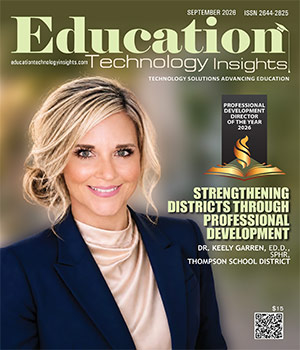
The cover story features Dr. Keely Garren, Ed.D., SPHR, Director of Professional Development at Thompson School District, named Professional Development Director of the Year 2026. Garren’s approach concentrates on building coherence, shared expectations and collective capacity rather than adding more initiatives to educators’ workloads. Her work illustrates how professional development can transcend compliance by linking learning to purpose, coaching and implementation. Her leadership is characterized by listening, evidence-based approaches and creating the opportunity for others to lead.
The featured technology companies have different applications within education. My Montessori Manual, named Top Montessori School Curriculum Management Platform 2026, gives schools a structured way to organize and preserve their own curriculum knowledge. Promova, recognized as Top Online Language Learning App 2026, focuses on helping learners build confidence through real-world communication, personalized learning and AI-supported conversation practice. SwiftDismiss, named Top School Dismissal App 2026, introduces a streamlined solution to the school dismissal challenge. Voyager Sopris Learning, recognized as Top K-5 Reading Intervention Solutions 2026, has built its approach around evidence-based instruction, structured literacy and strong educator support.
The CXO perspectives reinforce the importance of purposeful adoption. Eva Harvell, Director of Technology at Pascagoula-Gautier School District, emphasizes teacher support, clarity and trust when introducing technology and AI into classrooms. Mary Garofalo, Ph.D., Director of Learning Support Services at Kean University, stresses that data must be paired with empathy and that technology should strengthen rather than replace human relationships in student support.
Together, these stories demonstrate that effective education technology depends on more than new tools. It requires capable leaders, informed educators and systems designed around real learning needs. Explore the edition for perspectives on building that foundation for the future.
